
Deep Learning Based TSC#
There are a range of deep learning based classification algorithms in the toolkit. The networks that are common to classification, regression and clustering are in the networks module. Our deep learning classifiers are based on those used in deep learning bake off [1] and recent experimentation [2]. [3] provides an extensive recent review of related deep learning work.
A list of all deep learning classifiers
[3]:
import warnings

from aeon.registry import all_estimators

warnings.filterwarnings("ignore")
all_estimators("classifier", filter_tags={"algorithm_type": "deeplearning"})
[3]:
[('CNNClassifier', aeon.classification.deep_learning.cnn.CNNClassifier),
 ('EncoderClassifier',
  aeon.classification.deep_learning.encoder.EncoderClassifier),
 ('FCNClassifier', aeon.classification.deep_learning.fcn.FCNClassifier),
 ('IndividualInceptionClassifier',
  aeon.classification.deep_learning.inception_time.IndividualInceptionClassifier),
 ('MLPClassifier', aeon.classification.deep_learning.mlp.MLPClassifier),
 ('ResNetClassifier',
  aeon.classification.deep_learning.resnet.ResNetClassifier),
 ('TapNetClassifier',
  aeon.classification.deep_learning.tapnet.TapNetClassifier)]
The use case for deep learning classifiers is identical to that of all classifiers. However, you need to have tensorflow and tensorflow-probability installed in your environment. If you have a GPU correctly installed the classifiers should use them, although it is worth checking the output.
[2]:
from sklearn.metrics import accuracy_score

from aeon.classification.deep_learning import CNNClassifier
from aeon.datasets import load_basic_motions  # multivariate dataset
from aeon.datasets import load_italy_power_demand  # univariate dataset

italy, italy_labels = load_italy_power_demand(split="train")
italy_test, italy_test_labels = load_italy_power_demand(split="test")
motions, motions_labels = load_basic_motions(split="train")
motions_test, motions_test_labels = load_basic_motions(split="train")
cnn = CNNClassifier()
cnn.fit(italy, italy_labels)
y_pred = cnn.predict(italy_test)
accuracy_score(italy_test_labels, y_pred)
[2]:
(67, 1, 24)
InceptionTime and ResNet#
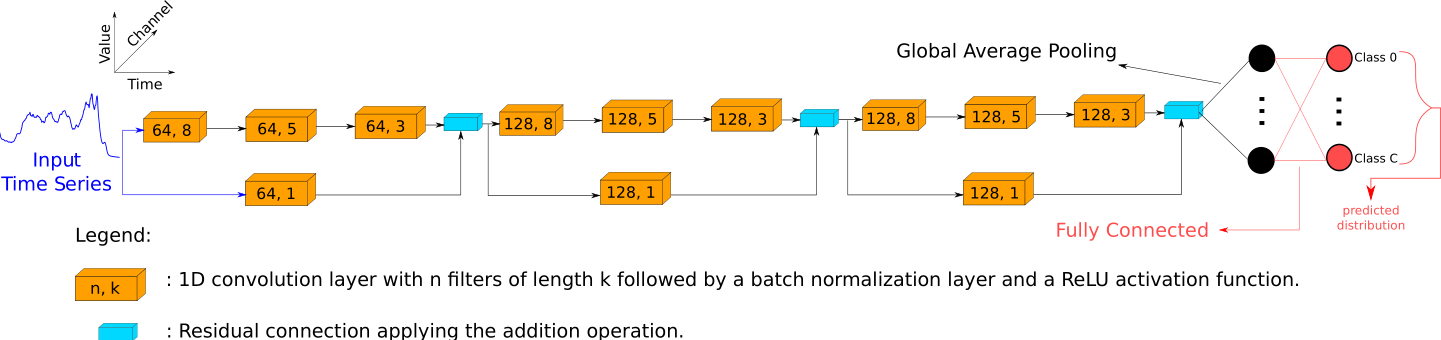
The deep learning bake off [1] found that the Residual Network (ResNet) was the best performing architecture for TSC. The aeon ResNetClassifier has the following network structure.
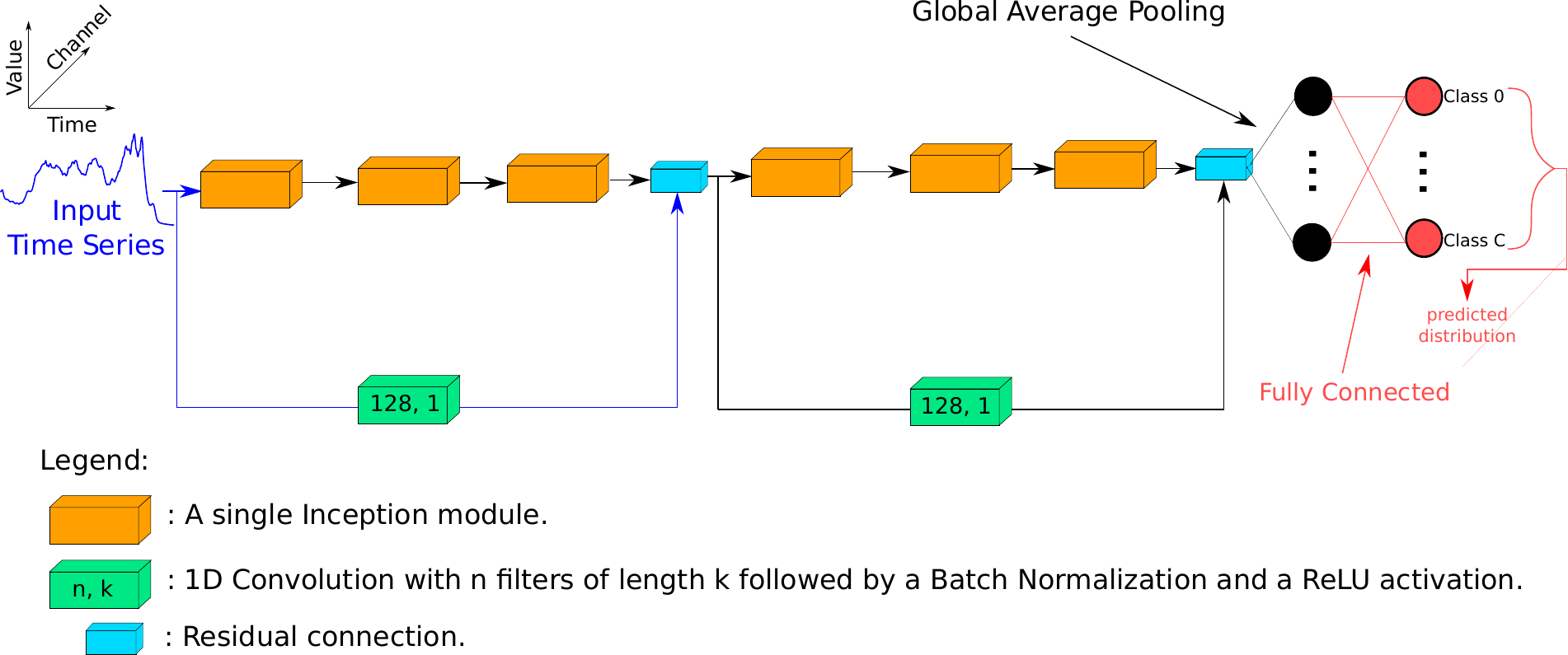
The Inception Time deep learning algorithm was proposed after this bakeoff. The aeon InceptionTimeClassifier is an ensemble of five SingleInceptionTime deep learning classifiers. Each base classifier shares the same architecture based on Inception modules. Diversity is achieved through randomly intialising weights. A SingleInceptionTimeClassifier consists of Inception modules.
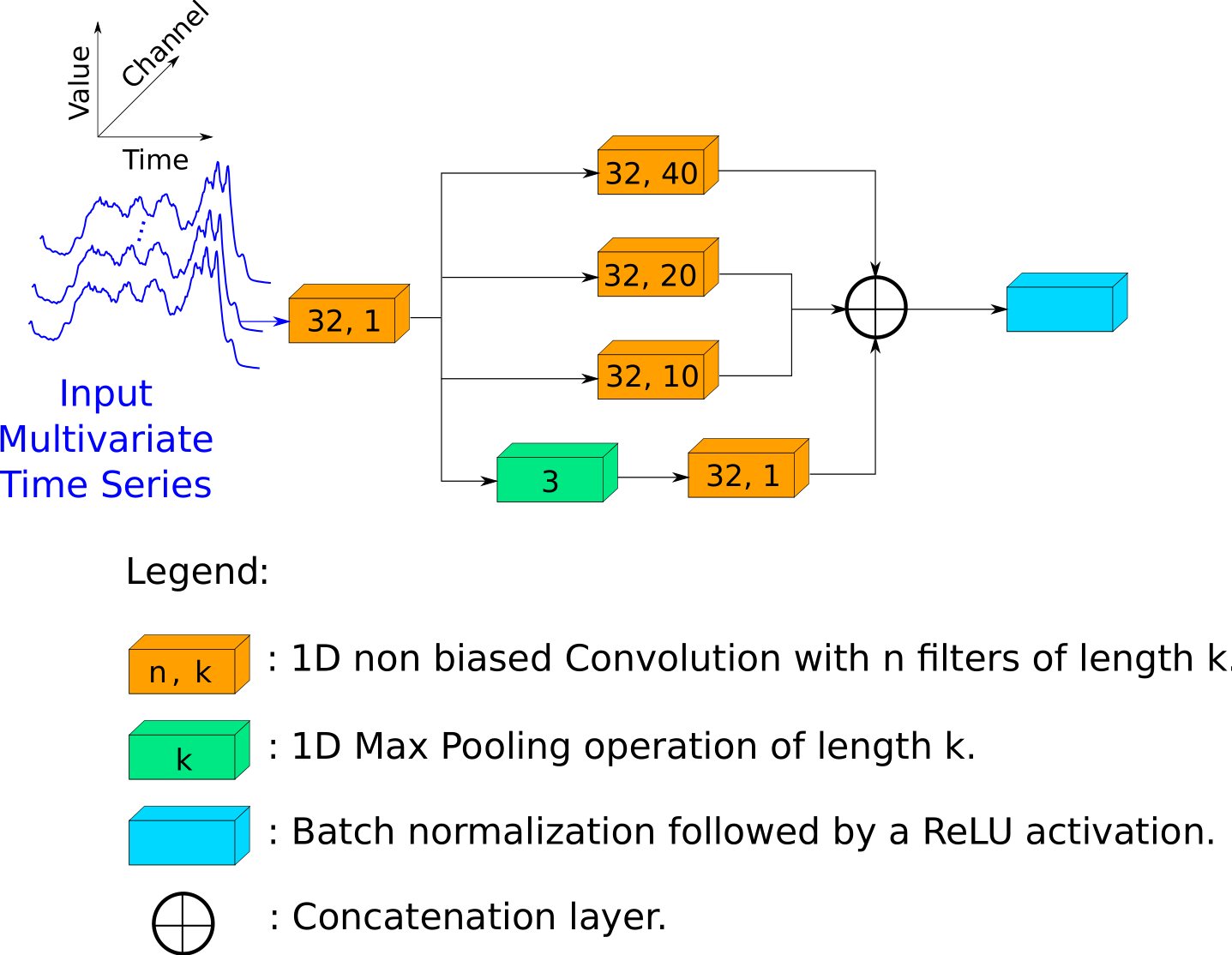
A SingleInceptionTimeClassifier is structured as follows.
References#
[1] Fawaz et al. (2019) “Deep learning for time series classification: a review” Data Mining and Knowledge Discovery. 33(4): 917-963
[2] Fawaz et al. (2020) “InceptionTime: finding AlexNet for time series classification. Data Mining and Knowledge Discovery. 34(6): 1936-1962
[3] Foumani et al. (2023) “Deep Learning for Time Series Classification and Extrinsic Regression: A Current Survey” ArXiv https://arxiv.org/pdf/2302.02515.pdf
Generated using nbsphinx. The Jupyter notebook can be found here.